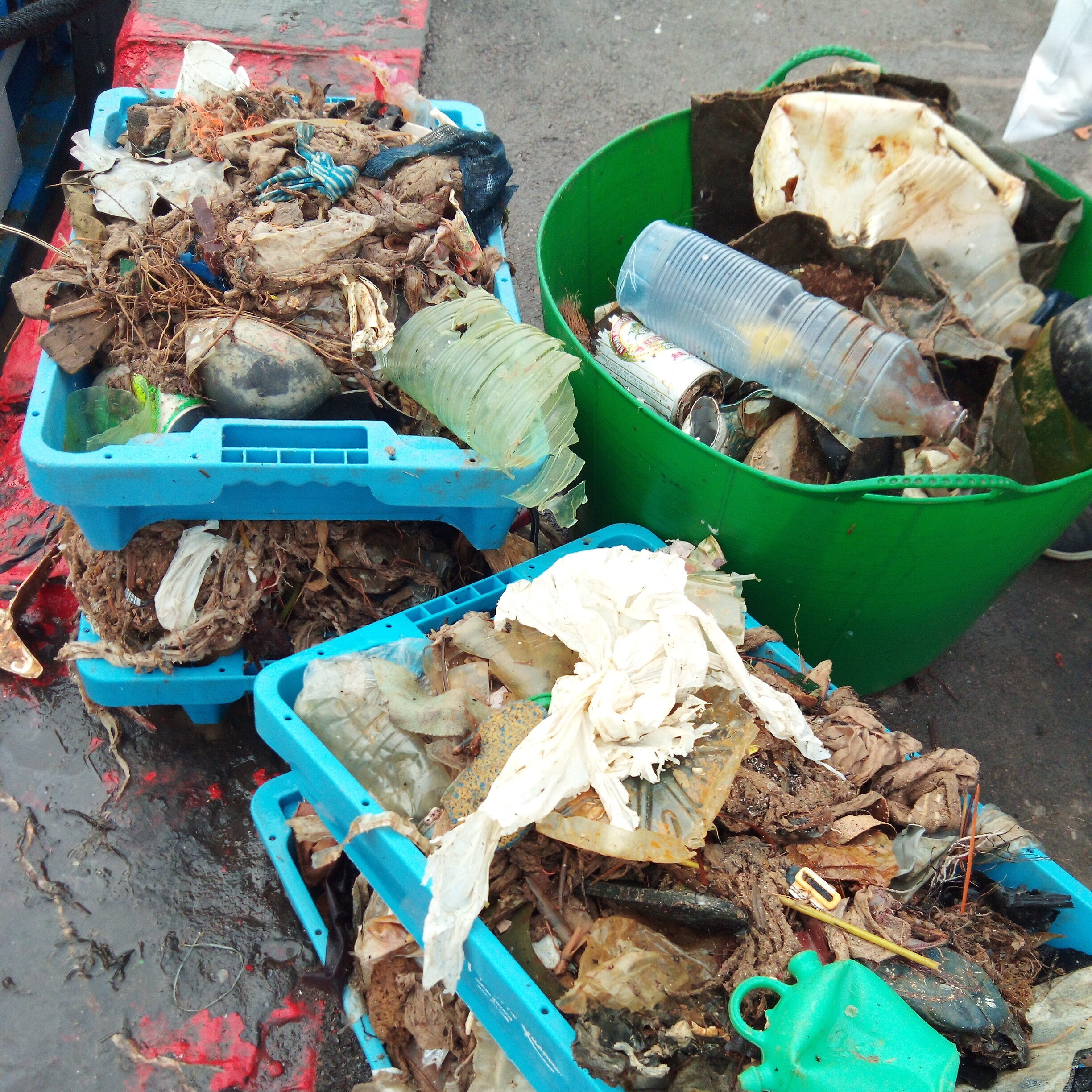
The characterization and analysis of the waste are carried out following the Fishing for Litter strategy, which provides key information on its typology and distribution.
The report’s conclusions show that marine litter continues to represent a small fraction of the total trawl fishing catches (around 2%), but it is present in all the areas and depths analyzed.
Plastic is the most frequent material, with an average of 5.08 kg/km² between 2020 and 2024. However, in 2024 metal was the predominant category due to a large metal container caught in Blanes.
The central areas of the Catalan coastline (province of Barcelona) concentrate the highest amounts of marine litter, with plastic as the dominant material.
This study is aligned with the objectives of the Estratègia Marítima de Catalunya 2030 and contributes valuable information to promote measures that reduce environmental impact and move towards more sustainable management of the marine environment.
You can now consult and download the latest reports on the state of fisheries in Catalonia in 2023 in the Publications section.
In State of Fisheries in Catalonia 2023, Part 1: Report on the Monitoring of the Commercial Fishing Fleet, the sampling methodology for different fishing modalities used by ICATMAR for monitoring fishery resources along the Catalan coast is presented. Regarding the sampling of trawling, this edition explains the shift in approach adopted to align with the European Common Fisheries Policy. This change consists of replacing the depth stratum, previously used as a spatial sampling unit, with métier, defined as a set of fishing operations targeting a similar group of species using similar fishing gear during the same period and/or in the same area.
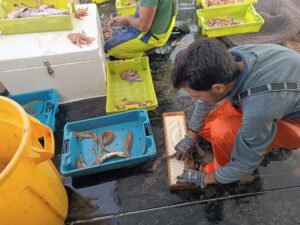
ICATMAR sampler measuring species on board a bottom trawling vessel.
Following this, the different sections present the monitoring results, which include the composition of the landed catches, discarded and accompanying species, and marine litter for each fishing modality. Additionally, for each modality, results are provided based on the data collected for the target species of bottom trawling (hake, red mullet, Norway lobster, blue and red shrimp, deep-water rose shrimp, spottail mantis squillid, and caramote prawn), purse seine fishing (European sardine and anchovy), and small-scale fisheries included in co-management plans (sandeels and transparent goby, common octopus, and blue crab). For each species, maps of catch distribution, biological parameters, size at first maturity, reproductive cycle, and size frequency distribution (for métiers in the case of bottom trawling) are shown.
On the other hand, State of Fisheries in Catalonia, Part 2: Stock Assessment presents the results of the stock assessments carried out by ICATMAR. Stock assessment aims to determine, through mathematical models, whether the exploitation of marine species populations is within sustainability limits. In this year’s report, assessments were conducted using two types of methodologies. On one hand, the LBSPR model (Length-Based Spawning Potential Ratio), which, considering size frequency and species biology, allows for the estimation of the reproductive capacity of populations. On the other hand, the SPiCT model (Stochastic Surplus Production Model in Continuous Time) allows for the estimation of fishing mortality and population status based on historical data on catches and biomass.
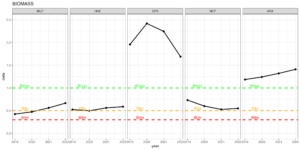
Results of stock assessment using the SPiCT model for demersal species included in the WMMAP: red mullet, hake, deep-water rose shrimp, Norway lobster, and blue and red shrimp.
Both models were used to assess the stocks of the main demersal species included in the WMMAP (West Mediterranean Multiannual Plan) of the European Union, namely hake, red mullet, Norway lobster, blue and red shrimp and deep-water rose shrimp, as well as the main small pelagic species, European sardine and anchovy. Since they are based on different assumptions and data, the two models employed, LBSPR and SPiCT, sometimes offer different perspectives on the status of the populations. Therefore, it is important that the information they provide is carefully analyzed when proposing management recommendations.
Looking to the future, ICATMAR will continue its program of monitoring fishery resources along the Catalan coast to gather long-term data, enabling the application of more complex models, such as SS3 (Stock Synthesis 3). These types of models allow for the integration of diverse information simultaneously, such as historical catch data, changes in fishing gear selectivity, or differences in population dynamics between sexes. For this reason, they provide results that are more aligned with reality and can become a powerful tool for developing management recommendations based on scientific evidence aimed at ensuring the sustainability of fisheries.
Valorem la teva privadesa
Utilitzem tecnologia com ara galetes al nostre lloc per personalitzar contingut i anuncis, oferir funcions de xarxes socials i analitzar el nostre trànsit. Feu clic per consentir l'ús d'aquesta tecnologia al web. Podeu canviar d'opinió i canviar les vostres opcions de consentiment en qualsevol moment tornant a aquest lloc.
Funcional
Always active
The technical storage or access is strictly necessary for the legitimate purpose of enabling the use of a specific service explicitly requested by the subscriber or user, or for the sole purpose of carrying out the transmission of a communication over an electronic communications network.
Preferències
The technical storage or access is necessary for the legitimate purpose of storing preferences that are not requested by the subscriber or user.
Estadístiques
The technical storage or access that is used exclusively for statistical purposes.The technical storage or access that is used exclusively for anonymous statistical purposes. Without a subpoena, voluntary compliance on the part of your Internet Service Provider, or additional records from a third party, information stored or retrieved for this purpose alone cannot usually be used to identify you.
Màrqueting
The technical storage or access is required to create user profiles to send advertising, or to track the user on a website or across several websites for similar marketing purposes.